Is Spin Dinero Legit? Licence, Reputation and Trust for Australians
 Available in AU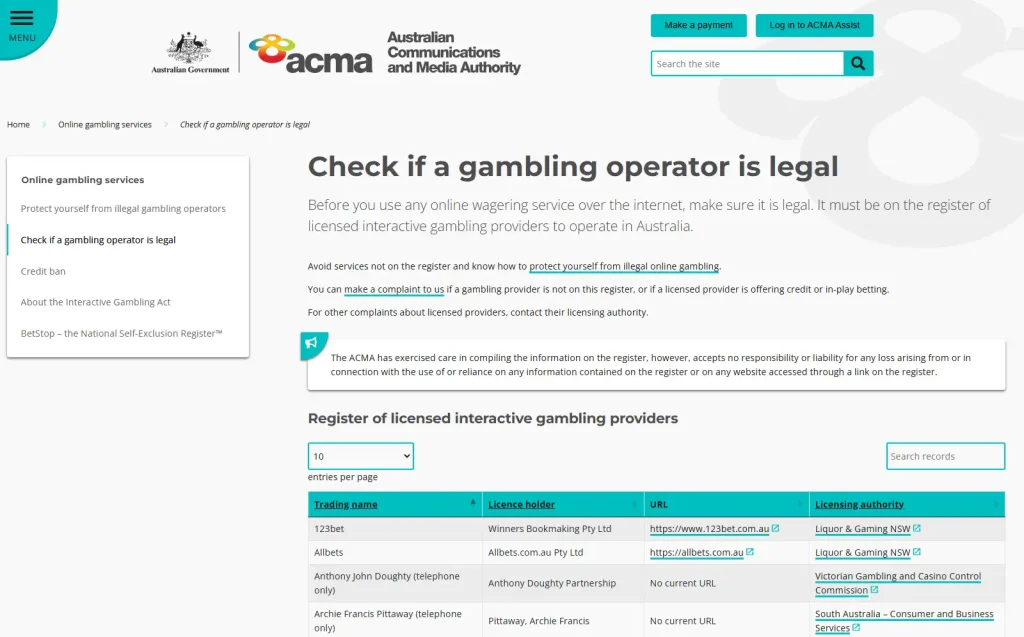
No Australian local licence was verified for Spin Dinero in the current ACMA register. This page also does not publish a current Curaçao licence claim, because an older offshore-registry record is not current enough to support that statement today. Those two points do not answer every trust question by themselves. A useful assessment separates local licensing, operator transparency, support and complaints procedures, withdrawal and verification rules, and public review signals. User reviews can identify themes worth checking, but they are not proof that an allegation is true or false. For the provider-side legal framework in Australia, including ACMA’s role and the Interactive Gambling Act 2001, see the Australian online casino law.
That layered approach is more informative than reducing the question to a one-word “legit” or “safe” label.
Table of Contents
- Start with the Australian licence question
- Do not treat an old offshore licence record as current proof
- Published support and complaints procedures are concrete trust signals
- Withdrawal rules deserve separate scrutiny
- Account verification is a process, not a badge of trust
- How to read Spin Dinero reviews and complaints
- What ACMA register absence does and does not tell you
- Security claims should stay evidence-based
- A practical trust checklist for Australian readers
- What this page supports
- Use an evidence hierarchy instead of a trust score
- Primary sources worth checking directly
Start with the Australian licence question
The first trust check for an Australian reader is whether the operator appears on the Australian Communications and Media Authority register of licensed interactive gambling providers. ACMA says an online wagering service must be on that register to operate as a licensed wagering provider in Australia. A current search of that register did not return Spin Dinero.
That supports one precise statement: no Australian local licence was verified for Spin Dinero. It does not justify broader claims about every aspect of the brand, and it does not establish what licences the operator may or may not hold in other jurisdictions. Local licensing is one fact category, not a substitute for checking the rest of the service.
This distinction matters because an offshore casino can present payment options, support channels and account tools to Australian users without thereby becoming an Australian-licensed wagering provider. For the legal difference between operational access and provider-side authorisation, use the dedicated Australian online casino law page.
Do not treat an old offshore licence record as current proof
An older offshore-registry record connected with the operator is no longer current enough to support a present-tense licence claim. Because licence numbers, status and expiry dates are high-risk facts, this guide does not recycle an expired or stale record into a statement that Spin Dinero currently holds a particular Curaçao licence.
For readers, the practical lesson is broader than this one brand. An offshore licence logo, a cached certificate, or a review article quoting an old number should not be treated as equivalent to a current regulator entry. A current licence claim should match a live regulator record or another current primary source.
That is why this page distinguishes between “no Australian local licence verified” and “current offshore licence status not asserted here.” Those are separate findings and should not be collapsed into a single label.
Published support and complaints procedures are concrete trust signals
Spin Dinero publishes a support page that lists email support and Live Chat, with the support page stating that users need to be logged in to use Live Chat. Its complaint procedure states that the customer service team is available 24 hours a day, seven days a week.
The complaint procedure is more useful than a generic promise of “good support” because it describes an escalation path. It says customers can contact the service team by email or Live Chat and says a final complaint decision will be given within four weeks. That does not guarantee a particular outcome, but it gives the reader something specific to evaluate: there is a published process, named communication channels and a stated decision window.
When assessing a casino, this kind of operational detail matters. A brand can make broad statements about service quality, but a written complaint process is easier to verify. Readers can compare what is published with their own experience and keep copies of relevant correspondence if an account issue develops.
Withdrawal rules deserve separate scrutiny
Trust assessment should also include what happens when money leaves the account. Spin Dinero’s official material states that a verified account is required before a withdrawal request and publishes baseline identity checks before withdrawal processing. Current terms also publish processing and fee rules. Those mechanics are covered in detail in the withdrawal process guide rather than repeated here.
The reason for separating them is simple: payment and KYC terms change more often than broad brand information, and exact fees, timing and document requirements are high-impact details. A trust page should point readers to the current mechanics without turning every payment condition into a permanent reputation judgment.
A useful test is whether the operator states the rules before a withdrawal problem occurs. Published minimums, verification requirements, processing stages and complaint routes are more actionable than vague claims about fast or reliable payouts.
Account verification is a process, not a badge of trust
The current account rules require verification before withdrawal processing, and the terms name a government-issued photo ID and proof of address as baseline documents while allowing additional validation requests. Those facts tell readers how the account process works. They do not, by themselves, establish whether the brand should be considered trustworthy overall.
That distinction prevents two common mistakes. The first is treating KYC as proof that an operator is locally regulated. The second is treating KYC itself as evidence of wrongdoing. Identity checks can exist at offshore operators as well as locally licensed services. The relevant question is whether requirements are clearly published, applied consistently and connected to an understandable account process.
For the practical registration and verification flow, including the one-account rule and mobile-browser access, see the account verification guide.
How to read Spin Dinero reviews and complaints
Public reviews are useful for discovering questions to investigate. They are much weaker as proof of what actually happened in a disputed account. A complaint about a delayed withdrawal, for example, may reflect a genuine service problem, an unresolved verification issue, a bonus condition, a payment-provider delay, or incomplete information from the reviewer. A review platform usually cannot determine that from the post alone.
The safest way to use review material is to look for repeated topics and then check those topics against first-party rules. If many comments mention withdrawals, examine the current withdrawal minimum, verification requirement, fees and processing terms. If comments focus on support, compare them with the published support channels and complaint procedure. If comments discuss game selection, verify the actual categories on the site rather than relying on older page captures.
Reviews therefore work best as a map of what to verify, not as a substitute for verification. This page does not reproduce individual accusations as factual findings and does not use a star rating to decide whether the casino is legitimate.
What ACMA register absence does and does not tell you
ACMA’s register is the authoritative place to check Australian licensed interactive wagering providers. Spin Dinero was not found in that register during the current check, so this guide does not describe the brand as Australian licensed or imply access to protections that apply to Australian licensed wagering services.
Register absence should still be interpreted precisely. It answers the local-licence question. It does not prove that the operator has no corporate registration, no offshore authorisation, no support process or no operational ability to accept an account. Those are different questions with different evidence.
ACMA also states that online casinos are among the services providers are prohibited from offering to people in Australia. That provider-side rule is important context, but separate brand-side information indicates operational acceptance. The distinction is explained fully on the Australian online casino law page.
Security claims should stay evidence-based
Spin Dinero’s terms describe security measures for sensitive account data, but broad marketing language about security should not be translated into an independent certification. This guide therefore focuses on observable controls and published processes rather than awarding a security score.
From a user perspective, practical account hygiene still matters: protect the password, use an email address you control, keep account details accurate, and do not share access. If a dispute develops, save transaction records and correspondence. Those steps do not prove anything about the operator, but they preserve the information needed to understand what happened.
Game availability is also separate from trust and licensing. Readers who want to inspect what the site actually offers can use the game library page rather than assuming a large catalogue says anything about regulatory status.
A practical trust checklist for Australian readers
| Question | What this review verified | How to use it |
|---|---|---|
| Australian local licence? | No Australian local licence was verified in the current ACMA register. | Do not assume Australian licensed-wagering protections apply. |
| Current offshore licence? | No current Curaçao licence claim is made here. | Require a fresh primary regulator record before relying on a licence number or status. |
| Support channels? | Email and logged-in Live Chat are published. | Check whether you can access support before depositing or withdrawing. |
| Complaint process? | A formal complaint procedure is published, with a stated four-week final-decision window. | Keep written records and use the published escalation route. |
| Withdrawal verification? | A verified account is required before withdrawal. | Complete account checks before relying on a balance being immediately cashable. |
| User reviews? | Treated as reputation signals, not adjudicated facts. | Use recurring themes to decide what primary terms to check. |
What this page supports
The evidence supports a structured assessment rather than a binary label. Spin Dinero has published support and complaint channels, a documented account-verification process and public terms that can be checked. At the same time, no Australian local licence was verified, and this guide does not make a current Curaçao licence claim without fresh primary confirmation.
For an Australian reader, those facts should be kept separate. Local regulatory status belongs in one column, current operational terms in another, and public reputation signals in a third. That makes it easier to distinguish what is verified from what is merely claimed or discussed online.
For the broader site overview, return to the Spin Dinero Australia review. For current law, ACMA enforcement, BetStop and Australian tax context, continue to the linked legal guide.
Use an evidence hierarchy instead of a trust score
A practical review can rank evidence by what it is capable of proving. A regulator register is the right source for an Australian licence claim. Current operator terms are the right source for account rules, verification requirements and complaint procedures. A current cashier or FAQ can establish operational features. Independent reviews and forum posts can show what users are talking about, but they cannot replace those primary sources for licence status or contractual rules.
This hierarchy also makes conflicting information easier to handle. If a review site says an operator is licensed in one jurisdiction but the available regulator record is expired or cannot be confirmed, the supported approach is not to choose whichever source sounds more reassuring. The current licence claim should remain unmade until primary evidence is available. If an operator page and a review site disagree about a current withdrawal rule, the current official rule should be checked directly before quoting a number.
For Australian readers, the same discipline applies to consumer protections. The presence of customer support, a complaint process or account verification does not mean the service is covered by the same framework as an Australian licensed wagering provider. Those features can still be evaluated on their own terms, but they should not be presented as regulatory equivalence.